Patents
Patents and certificates, in the open.
We sell to brands and distributors, so the first thing you want to know is who actually owns the design. Here is the number, what it covers, and a list you can download and check yourself.
Want to build a product on top of these mechanisms? Talk to us about OEM / ODM →
The two companies are one team: HK 4 Degree Co., Ltd. designs and exports, Foshan Mia Electrical Appliance Manufacturing Co., Ltd. makes. Patents filed under either name are counted together.
The full list (PDF)
Every patent in force, with application number, publication number, filing date and expiry — 56 entries, updated 24 September 2026.
Where the protection actually sits
Fifty-six rights in force, grouped by what they protect rather than by patent number. Six blocks, and together they are exactly the 56 — one right per block, none counted twice. A copyist has to get past one of these walls, not past a number.
Air path — how the gas goes in, and how it comes out
10 rightsOne-way gas admission (gas in, water cannot come back and foul the machine), bottom-feed injection, the pump unit, two-stage release (slow first, then fast), a release-free outlet, linked pumping. This is the part a copyist has to reproduce exactly, because it is what makes the drink — and the part cheap machines skip.
- CN208768868U · one-way gas supply unit (SHANG)
- CN210687132U · CN210871078U · pressure release
- CN221012900U · pump unit
- CN216494850U · bottom-feed injection
- CN221690685U · release-free outlet
- CN223614587U · linked pumping
- + 4 further utility models in this block
Flavour injection and mixing — the mix-and-carbonate line
5 rightsInjecting flavour into a sealed bottle, the mixing structure inside it, two-flavour machines, the soda juicer, and the modular machine built around syrup. This block is the mix line's own wall: a water-only machine has no equivalent to it.
- CN222194729U · flavour injection device
- CN222018149U · flavour-mixing structure
- CN223715517U · two-flavour machine
- CN215937070U · soda juicer
- CN221963413U · modular machine for syrup
Electronic control and automation
4 rightsElectronically metered carbonation and release, the travel-limit mechanism, a machine plus its management system, and the SMARTZZI control panel as a design. Four rights today — and the solenoid valve for the DRINKSIT carbonation chamber is filed as an invention, still under examination (2026-09-15).
- CN221411012U · electric carbonation
- CN222751841U · travel limit
- CN212460665U · machine + management system
- CN310208093S · SMARTZZI control panel (design)
The interfaces — cylinder end and bottle end
14 rights · our deepest blockHow a CO₂ cylinder locks onto the machine, the valve assembly and the locking structure around gas injection; and on the bottle side, hanging the bottle so it lines itself up onto the gas port, one-press mounting and release, the locking assembly, the swing structure and the bottle seal. Any machine that takes a cylinder and hangs a bottle has to solve these same problems — which is why this is the block we took international.
- CN224756756U · cylinder quick-connect
- CN224099167U · quick assembly (the PCT parent)
- CN224261451U · valve assembly
- CN224261447U · locking structure for gas injection
- CN221785974U · CN221769780U · self-aligning bottle hang
- CN221105530U · SING hanging-bottle mount
- CN221012899U · bottle swing structure
- CN223554657U · CN223554662U · CN223614597U · mount, release, locking
- CN222018148U · quick-release structure
- CN224563189U · bottle seal
- CN212755233U · drinking-water device and bottle
Containers and attachments
9 rightsThe parts that keep a customer buying after the machine: the insulated pressure-holding cup, the insulated bottle (utility model plus design), the tumbler and the juice cup that takes the blender head, the sparkling-water cup, and the cream machine, cream bottle and their designs.
- CN218186476U · insulated pressure-holding cup
- CN223759711U · CN309420353S · insulated bottle
- CN308367791S · tumbler
- CN308671656S · juice cup for the blender head
- CN217243659U · sparkling-water cup
- CN223554238U · CN309424959S · CN309420637S · cream machine and bottle
Industrial design, across the range
14 rightsDesign registrations covering how the machines look — the models we filed between 2017 and 2024, SHANG, SONG, SING, SHANG X and SMARTZZI among them. Design protects appearance and nothing else: it is the cheapest block to design around, which is exactly why we list it as its own block rather than folding it into the others.
Counts are the rights in force today, by the block each mainly protects. Where a title is generic (“sparkling water machine”), it is counted here but not spelled out; the PDF lists every entry. Every code above is a publication number you can check at CNIPA, free of charge.
How far a Chinese patent actually travels
A patent is territorial. A Chinese patent stops copies made or sold in mainland China — it does nothing in the United States, the EU or the Gulf. That sentence is more useful to a buyer than a bigger number. Here is how we extend it, and where it reaches today.
The priority window, and why it matters
Under the Paris Convention a Chinese filing gives us 12 months (invention and utility model) or 6 months (design) to file in other countries and keep the Chinese filing date. Miss the window and our own publication can be cited against us. One asymmetry is worth knowing: the United States has no utility model, so a Chinese utility model buys nothing there — protection in the US means an invention filing or the PCT route.
What we have filed outside China
One application, and it sits on the interface block: PCT/CN2025/145383 — quick-assembly structure and soda maker — accepted 2025-12-25, claiming priority from the Chinese filing of 2025-04-14. A PCT application buys 30 months from the priority date to decide which countries to enter, with one application and one search. That decision falls due by 14 October 2027, and we plan the United States and the European Union. The same mechanism also has an invention application under examination (202511199174X). Everything else on this page is China-only.
What that means for your project
Tell us where you sell. In an OEM/ODM project we can file in your market on the mechanism you are buying, and write into the agreement who owns the filing, who pays the annuities and who may use the design. If you already hold rights in your market we will not compete on paper with you: ownership, licence and territory are settled before tooling starts. On enforcement in China, the lever for goods crossing the border is a customs IP recordal. We have not filed one, and we will not claim otherwise — if your project needs that lever, it is a short filing and we will make it.
What no patent gives you — ours included
Exclusivity. A patent is a right to exclude, not a promise that nobody else will sell something similar; a period of exclusivity belongs in the commercial terms. A grant of invention. Of our four invention applications, two are still under examination and two were abandoned; every granted right we hold is a utility model (36) or a design (20). Scope beyond what is claimed. A utility model covers structure; change the structure and it no longer bites — which is why the interface block has fourteen of them.
The three kinds of Chinese patent, in three lines
- Invention protects the principle — examined for novelty before grant, 20 years.
- Utility model protects the structure of a working part — formal check only, 10 years, narrower and easier to work around.
- Design protects how the product looks — 10 to 15 years, and appearance is easy to change.
Our portfolio holds 36 utility models and 20 designs in force, and no granted invention: of four invention applications, two are under examination and two were abandoned. The full reading — including why a Chinese utility model buys nothing in the United States — is in the buyer guide Reading a patent list.
What they actually cover
Gas in, water stays out
One-way air admission and the gas supply unit — the mechanism that lets the machine carbonate juice, tea or fruit without the drink running back into the machine.
Two-phase pressure release
Automatic and manual release, slow then fast, so nothing sprays when you open the bottle.
Bottle and bottle lock
The hanging bottle that lines itself up with the gas port, the wide-mouth bottle you can drop fruit into, and the 17 bar bottle.
Cream machine and CO₂ parts
Locking structures, gas valves, quick-connect cylinders and the 8 g capsule line.
Why this list matters when you are the buyer
A patent list is not a trophy cabinet. For a brand owner placing an order, it answers four questions that a catalogue never does.
You can see who owns it
A supplier who licensed the design from somewhere else appears on the patent as a licensee, not an applicant. Every entry in our list carries 4° or MIA as the applicant, because we filed it.
You can tell protected from ordinary
Half of what a catalogue calls “patented” is a hinge. This page names the four things that are actually protected — and, just as usefully, tells you what is not.
You can check it before you sign
The list has application and publication numbers. Look them up at CNIPA yourself, or hand the PDF to your lawyer. We would rather you did.
It tells you what we can defend
If a competitor copies the one-way gas admission or the click-and-hang bottle lock, there is a registered right behind it. That is the difference between a complaint and a case.
Check it yourself, in three steps
- STEP 1Download the list
One PDF, 56 entries in force, each with the applicant, filing date and publication number.
- STEP 2Pick a number
Take any application number — for example the one-way gas admission patent on the mix line.
- STEP 3Look it up at CNIPA
Search the number at the China National Intellectual Property Administration. It is public, and it is the same document we hold.
A look at four of them
Four originals, spanning both kinds we hold — utility model and design. Click any certificate to open it full size: the certificate number, the patent number and the CNIPA seal are all on the page.
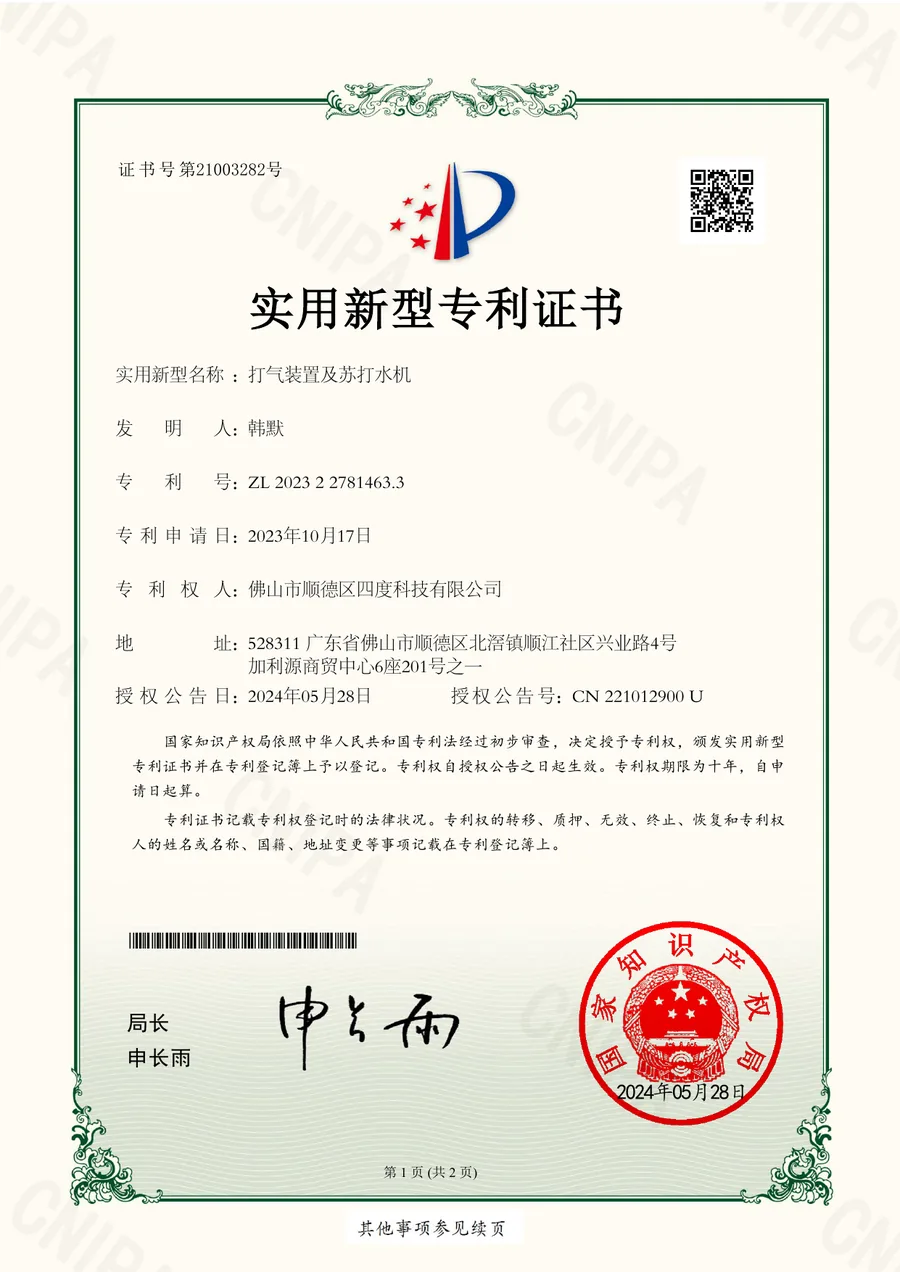
Utility model · ZL 2023 2 2781463.3 · granted 2024-05-28
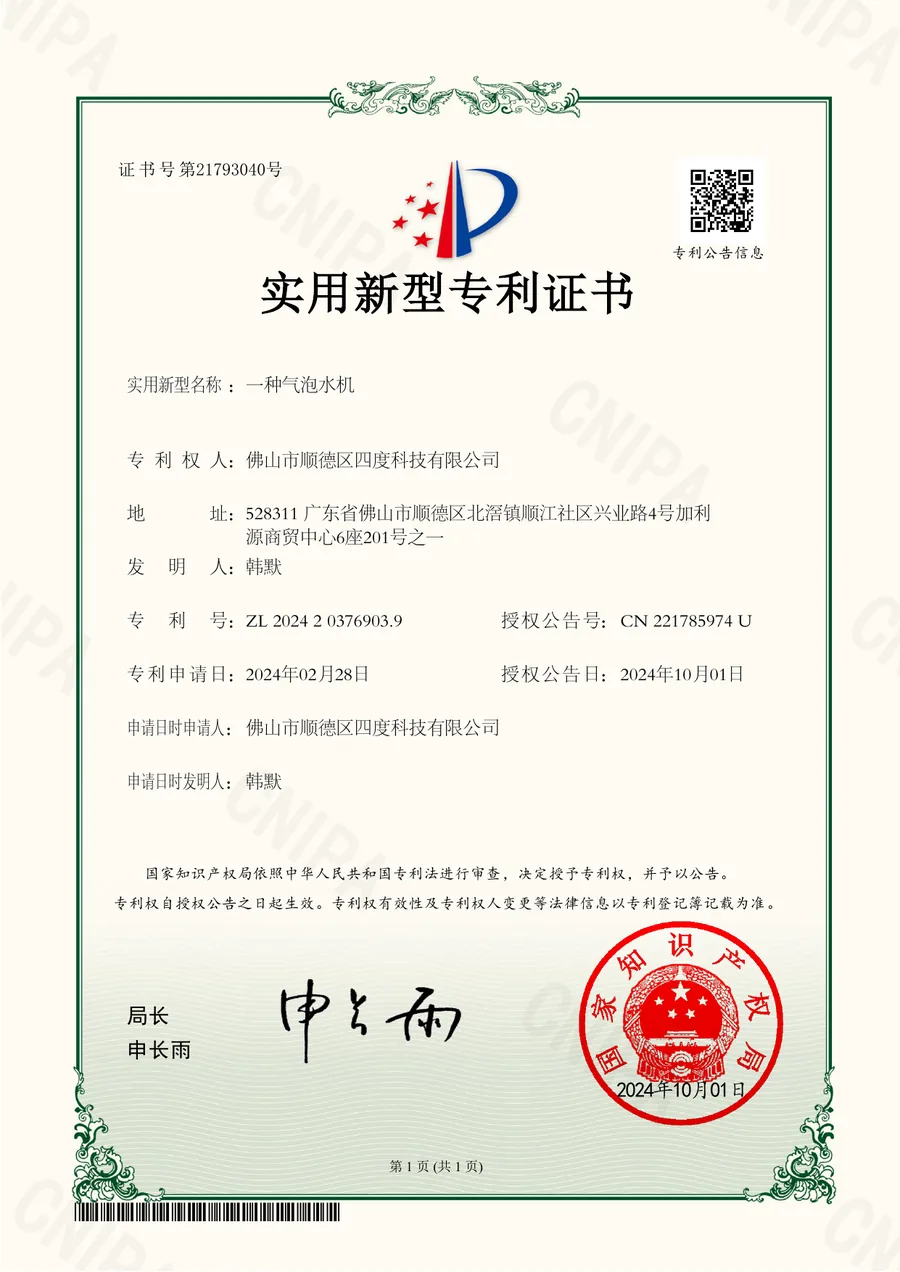
Utility model · ZL 2024 2 0376903.9 · granted 2024-10-01
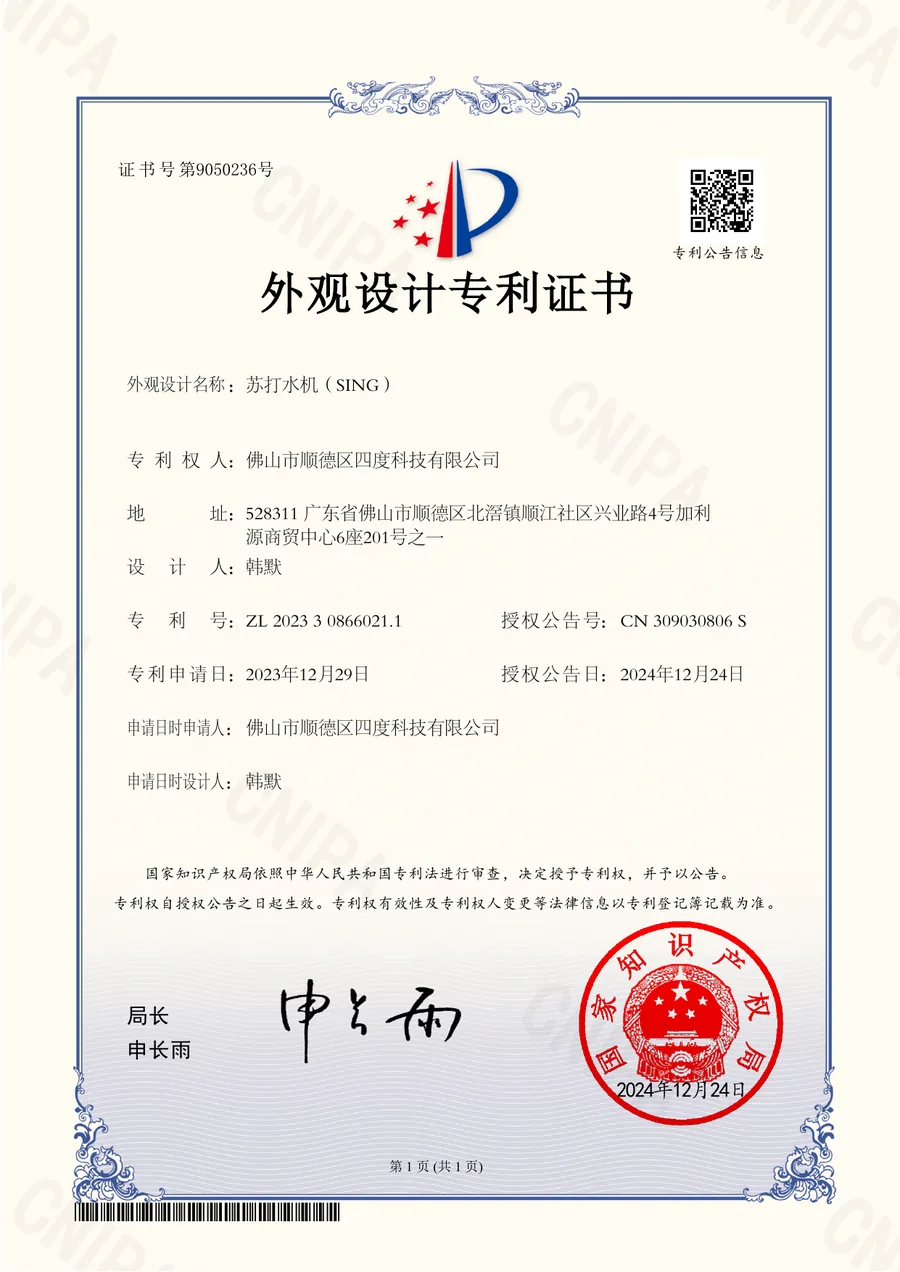
Design · ZL 2023 3 0866021.1 · granted 2024-12-24
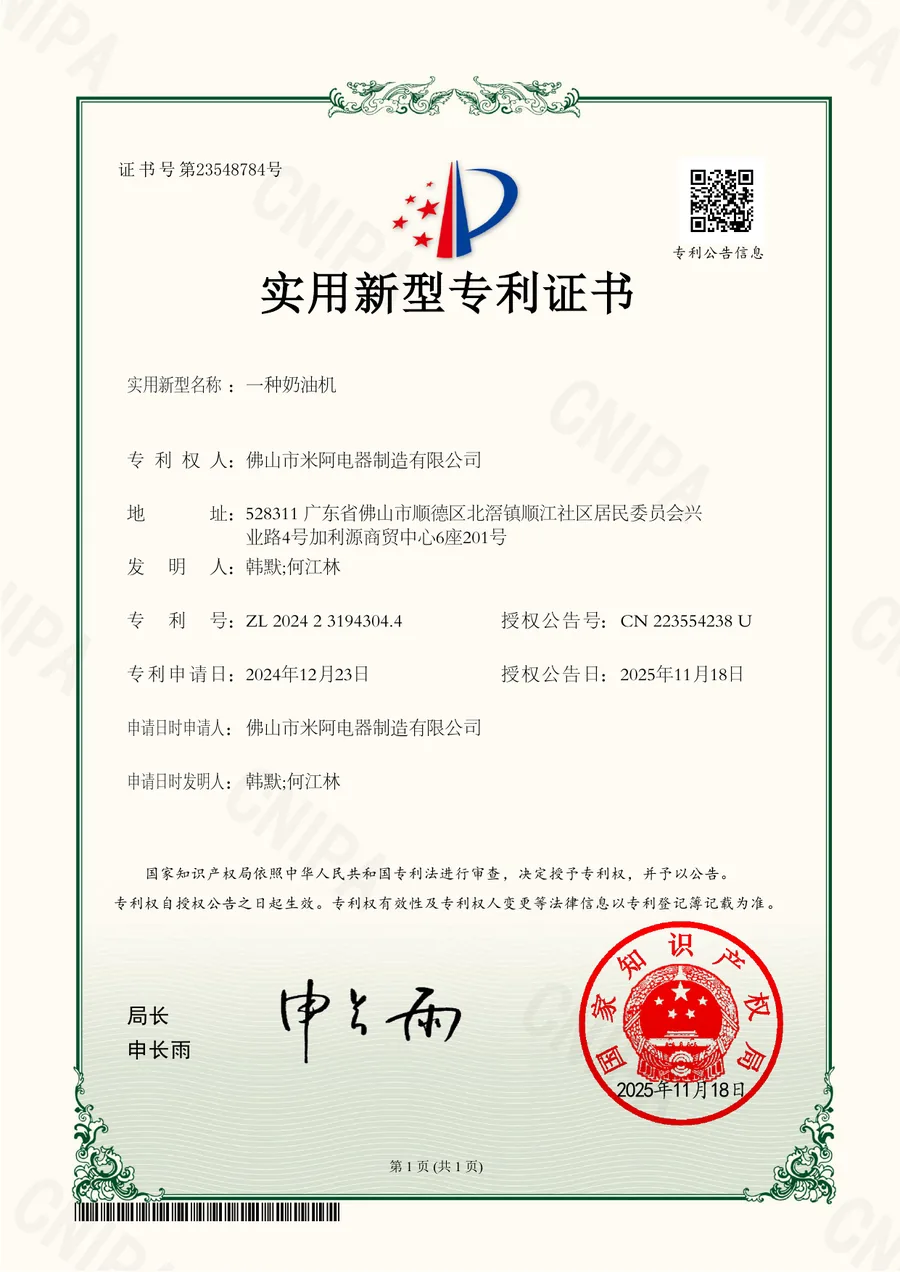
Utility model · ZL 2024 2 3194304.4 · granted 2025-11-18
Certificates
ISO 9001 and ISO 14001 (issued 2025-08-12, valid to 2028-08-05, scope: R&D and assembly of soda makers), BSCI social audit, packaging PPWR, LFGB, RoHS, REACH, FDA, PET GB 4806.6, CO₂ CoS and MSDS, TPED and DOT for cylinders. Scans of the originals are on the Why 4° page.
Not sure which of these your market will ask for? There is a guide on what importers ask for and how to verify each document.
Want a signed copy for your legal file, or a patent-to-model mapping? Ask us — we answer with the document, not a brochure.
Questions buyers ask us about the patents
→ How many patents does 4° hold?
Seventy-five applications filed across 4° and Mia together — 60 granted, 56 of those still in force. The two companies are one group, so the count is combined. By type: 43 utility models, 26 designs, four inventions and one PCT filing. The granted 60 are utility models (including one Taiwan utility model) and designs; our invention applications are still under examination. What they cover is the mechanism itself — carbonation, gas admission and release, bottle attachment, CO₂ parts and the dispensing side. The full list, with applicant and numbers, is the free PDF on this page.
→ How do I check a patent myself?
Download the list, take any application number, and search it at CNIPA — the China National Intellectual Property Administration. It is public, and it is the same document we hold. You do not need our permission, and you should not take our word for it.
→ Do these patents cover the machine you would build for me?
They cover the mechanisms we developed and still use: one-way gas admission that keeps water out of the machine, the click-and-hang bottle attachment, two-stage pressure release, the carbonation chamber and its control valve, and the CO₂ cylinders and cream-machine parts. What a patent does not give you is exclusivity — if you need a period of exclusivity, that belongs in the commercial agreement, not in a patent.
→ Are certificates the same thing as patents?
No, and most buyers need both. Patents protect the design; certificates prove the factory. ISO 9001 and ISO 14001 issued 2025-08-12 and valid to 2028-08-05, BSCI social audit, packaging PPWR, LFGB, RoHS, REACH, FDA, PET GB 4806.6, CO₂ CoS and MSDS, and TPED plus DOT for cylinders. Scans of the originals are on the Why 4° page.
→ Who owns the design when you build our model?
It is settled in writing before work starts. We have run OEM and ODM since 2013, and tooling ownership, design attribution and who may sell the result are written into the agreement rather than argued about after the first shipment. If your legal team wants a signed copy of anything on this page, ask and we send the document, not a brochure.
→ Do these Chinese patents protect us outside China?
No — patents are territorial. A Chinese patent stops copies made or sold in mainland China and does nothing in the United States, the EU or the Gulf. What a Chinese filing gives us is a priority window: 12 months (invention and utility model) or 6 months (design) to file elsewhere and keep the Chinese filing date. We have one international application running — the cylinder-and-valve quick-connect, PCT/CN2025/145383, accepted 2025-12-25, priority date 2025-04-14 — with the national-phase decision due by 14 October 2027, and we plan the United States and the European Union. The rest of the portfolio is China-only, and you should read it that way. If your market needs local rights, we file there as part of the project.
→ Is your quick-connect patent protected outside China, then?
It is on the way, and only on that mechanism. The Chinese utility model CN224099167U is granted and in force; the same mechanism has a PCT international application (PCT/CN2025/145383, accepted 2025-12-25, priority 2025-04-14) plus an invention application under examination (202511199174X). We plan to enter the United States and the EU at the 30-month deadline, 14 October 2027. Until those national filings are granted, nothing on that mechanism is enforceable abroad — and we would rather say so than let a slide imply otherwise.